The way businesses handle repetitive, multi-step processes is changing fast. In 2026, AI agents — autonomous software programs that perceive context, make decisions, and take actions without constant human input — have moved from experimental curiosity to production-ready infrastructure. If your team is still relying on rigid, rule-based automation or manual handoffs between departments, you're leaving compounding efficiency gains on the table.
What Makes an AI Agent Different from Traditional Automation
Tools like Zapier or n8n are powerful for linear, predictable tasks: if X happens, do Y. They work until conditions fall outside the script, and then they fail silently or noisily.
An AI agent goes further. It pairs a large language model with tools, memory, and a decision loop. Rather than following a fixed sequence, a well-built agent:
- Reads context from multiple sources — emails, databases, documents, APIs
- Decides which actions to take based on that context
- Executes those actions through connected tools
- Reflects on the result and adjusts its next step accordingly
The practical difference is significant. Traditional automation can move a file when a form is submitted. An AI agent can read that form, draft a personalised reply, check your CRM for existing contact history, book a discovery call, and notify your sales team — end to end, without a human in the loop.
Where AI Agents Deliver the Biggest ROI
Not every process suits agentic automation. The highest-value candidates tend to share a few traits: they're frequent, they involve unstructured data like text or PDFs, and they require contextual judgment that trips up rule-based systems.
Customer Support and Ticket Triage
An agent integrated with your helpdesk can classify incoming requests, retrieve relevant account history from your CRM, draft responses to Tier-1 queries, and escalate genuinely complex cases to human agents. Teams using this pattern consistently handle higher volumes without adding headcount.
Lead Qualification and Outbound Outreach
An agent can monitor inbound lead signals, enrich contact data from third-party sources, score leads against your ideal customer profile, and trigger personalised outreach sequences — all within minutes of a prospect showing interest, rather than hours.
Internal Knowledge and Operational Requests
Employees routinely spend time searching internal wikis, chasing approvals, or answering recurring procedural questions. An agent connected to your knowledge base, HR platform, and project management tools can field these requests conversationally and take direct action — submitting a leave request, raising a support ticket, booking a meeting room.
Real-Time Data Monitoring and Reporting
Instead of scheduled batch reports, an agent can watch KPIs continuously, detect anomalies, generate plain-language summaries, and push alerts to Slack or email — giving decision-makers timely context without manual analysis.
The Technical Building Blocks
A production AI agent typically comprises five layers:
- LLM backbone — the reasoning engine. The choice between hosted models and on-premise deployments depends heavily on data sensitivity and latency requirements.
- Tool layer — the functions the agent can call: web search, database queries, API requests, file read/write operations.
- Memory — short-term context (conversation thread) and long-term storage via vector databases or structured SQL so the agent retains knowledge across sessions.
- Orchestration framework — the loop managing think-act-reflect cycles. Options like LangGraph, CrewAI, or custom implementations each have different trade-offs around transparency, debuggability, and complexity.
- Human-in-the-loop checkpoints — guardrails that pause execution and request approval on high-stakes actions before they take effect.
Single-agent architectures work well for contained, linear tasks. Multi-agent systems — where specialist agents collaborate under a coordinating agent — are better suited to workflows that cross departmental or system boundaries.
Common Pitfalls to Avoid
Starting too broad. Agents that try to do everything generally do nothing reliably. Begin with one well-scoped, high-frequency process and expand only after the first agent has proven itself in production.
Skipping human-in-the-loop design. Autonomous does not mean unsupervised. For any action with real-world consequences — sending emails, updating records, processing payments — build in approval checkpoints until the agent has demonstrated consistent reliability.
Underestimating integration complexity. The AI reasoning layer is often the straightforward part. Connecting cleanly to legacy systems, authenticating against internal APIs, and handling edge cases in real-world data typically takes more engineering time than anticipated.
Neglecting security and access governance. An agent with access to your CRM, inbox, and file storage holds significant permissions. Scope those permissions to exactly what the agent needs, log every action it takes, and audit regularly.
A Practical Path to Your First Agent
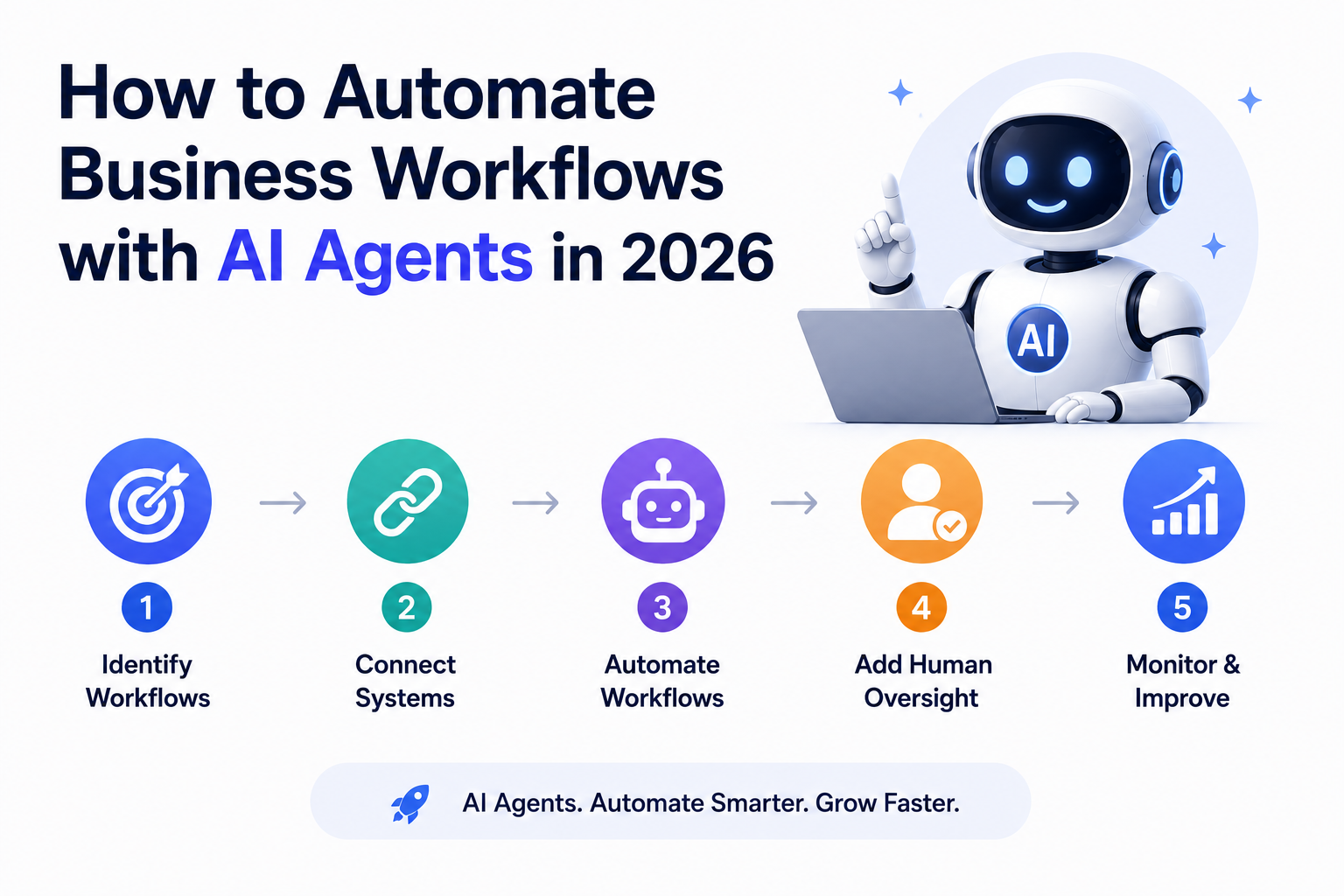
- Audit your workflows — list the five processes your team finds most repetitive, error-prone, or time-consuming.
- Score each for automation fitness — is the task frequent? Does it involve unstructured data? Does it require judgment a fixed rule can't provide?
- Choose one pilot — define clear success metrics and set a focused 6–8 week build-and-evaluate window.
- Select your stack — match the framework and model choice to your team's capabilities and your organisation's data-privacy requirements.
- Build, observe, and expand gradually — treat the first agent like a new team member: review its outputs, correct mistakes, and increase its autonomy only as trust is earned.
The Bottom Line
AI agents are not a future technology — they are a present opportunity. Businesses investing in identifying the right workflows and building reliable agents today are creating a compounding operational advantage. The barrier to entry has dropped considerably in 2026, but production-ready agents still require serious engineering, security thinking, and product judgment to get right.
If you'd like to explore which of your processes are ready for agentic automation, get a free consultation with our team — we'll help you cut through the hype and build something that actually delivers.
Want help putting this into practice?
We scope every project up front with a clear plan, timeline and estimate — no sales pitch.
Get a Free Consultation