One of the first big decisions in any mobile project is how the app will be built: natively for each platform, or once with a cross-platform framework like Flutter or React Native. It is often framed as a technology debate, but the right answer is almost always a business decision. Here is how to make it without the hype.
What the terms actually mean
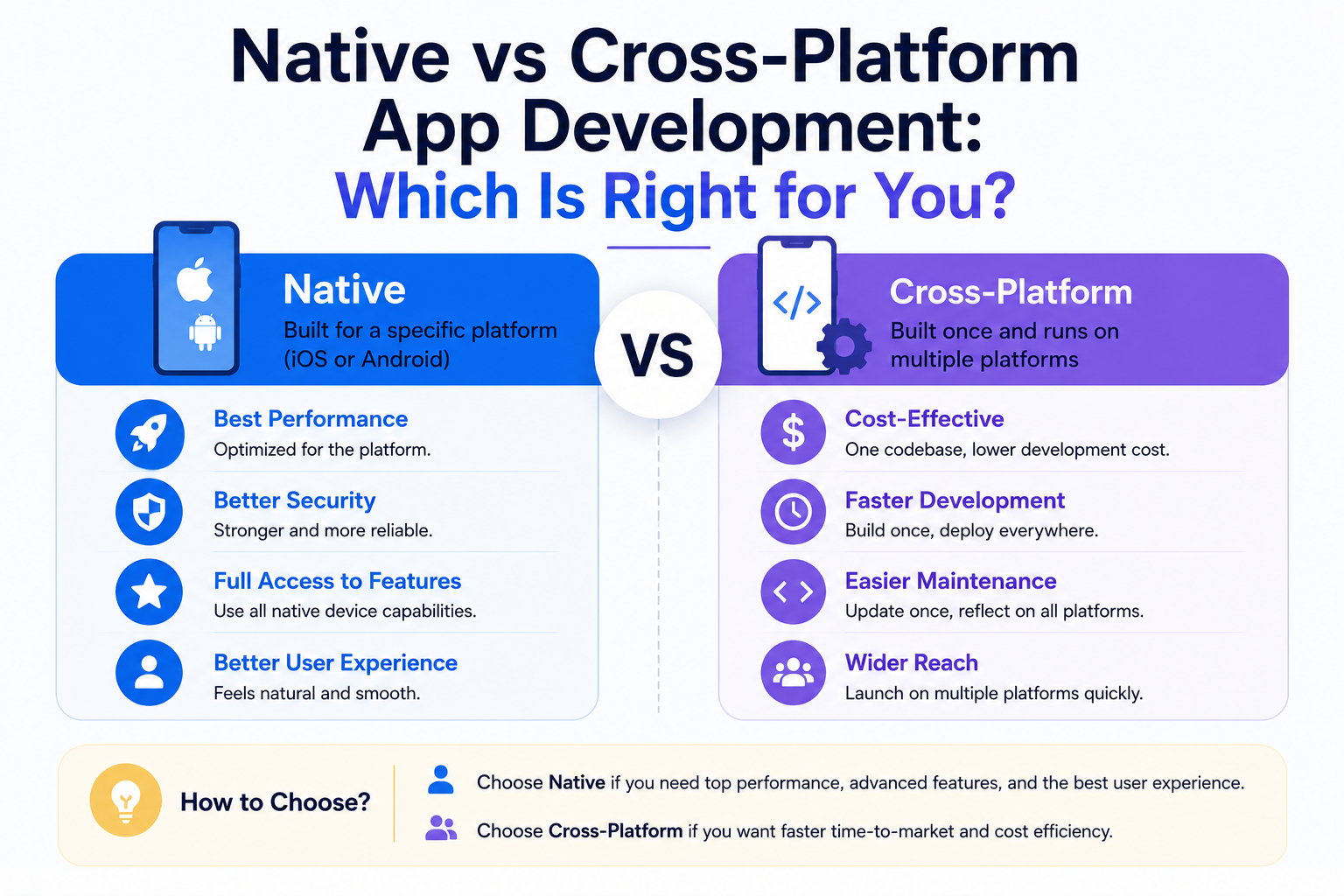
Native development means building separately for each platform using its own tools — Swift for iOS, Kotlin for Android. You get the deepest access to the device and the smoothest possible feel, at the cost of maintaining two codebases.
Cross-platform development means writing one codebase that runs on both platforms. Modern frameworks like Flutter and React Native have closed most of the historical gap in quality, and for the large majority of apps the difference is invisible to users.
When cross-platform is the smart choice
For most products, cross-platform is the pragmatic default in 2026:
- You want to launch on iOS and Android together without paying for two builds.
- Your app is mostly screens, forms, lists and API calls — which describes the vast majority of apps.
- Speed and budget matter, and a single team shipping one codebase is simply more efficient.
- You expect to iterate quickly, since one change updates both platforms at once.
Flutter excels when you want pixel-perfect, highly custom interfaces and consistent behaviour across devices. React Native is a strong fit when you have web React expertise or need tight integration with an existing JavaScript ecosystem.
When native is worth the extra cost
Native earns its premium in specific situations:
- Heavy use of device hardware — advanced camera processing, Bluetooth, AR, or background sensors.
- Performance-critical apps like high-end games or real-time graphics.
- Platform-specific experiences where you want to adopt each OS's latest features the day they ship.
If your app's entire value lives in squeezing the most out of the device, native is usually the right investment.
The questions that actually decide it
Forget the frameworks for a moment and answer these:
- Do you need both platforms at launch? If yes, cross-platform saves the most.
- How custom or hardware-dependent is the core experience? The more demanding, the stronger the case for native.
- What is your team's existing expertise? Building on strengths reduces risk.
- What is your iteration speed? Frequent updates favour a single codebase.
A practical recommendation
For startups and most business apps, we recommend starting cross-platform with Flutter or React Native. It gets you to market on both platforms faster and cheaper, and it is more than capable of a premium experience. Reserve native for the cases where the device truly is the product.
The wrong move is choosing based on what is trending. The right move is choosing based on your users, your roadmap and your budget.
If you are weighing this decision for a specific app, talk to our team — we will recommend the approach that fits your goals, not the one that is fashionable.
Want help putting this into practice?
We scope every project up front with a clear plan, timeline and estimate — no sales pitch.
Get a Free Consultation