
E-Commerce Management software for Indian businesses
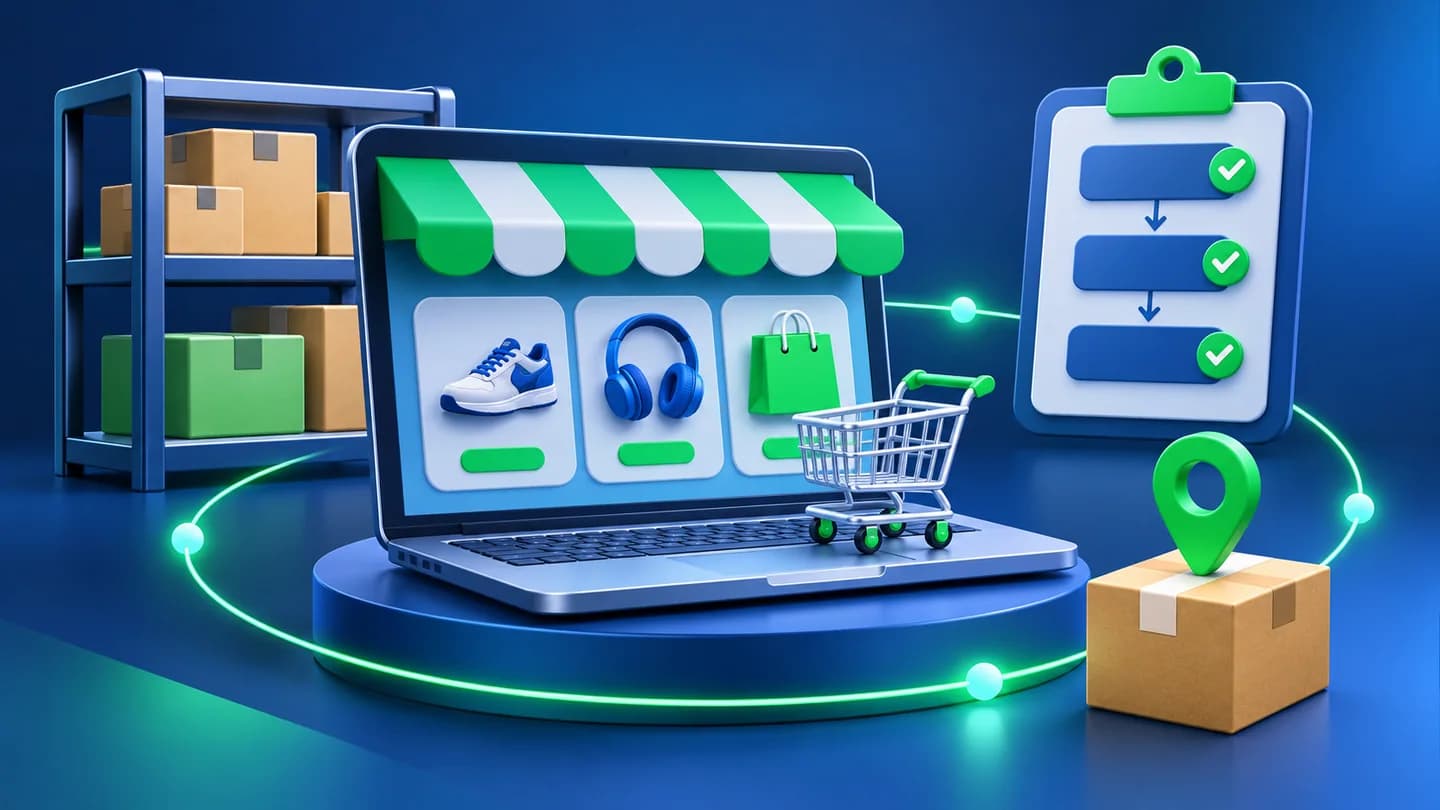
E-commerce management software runs the operations of one brand's online store: catalogue, pricing, stock, orders, payments, shipping and returns. D2C brands and retailers selling online use it to keep the website, marketplaces and warehouse in step. It differs from a marketplace platform because the business sells its own inventory rather than onboarding other sellers.
Problems e-commerce management software solves
- Stock sold on a marketplace is still shown as available on the website, leading to cancellations.
- Prices and offers are changed by hand in several places and drift out of sync.
- Orders are copied from the store into courier portals one by one, which slows dispatch.
- Returns and refunds are tracked in messages, so refund timing and reasons are unclear.
- Cash-on-delivery orders are shipped without checks and often come back undelivered.
What e-commerce management software should do
The capabilities to expect, and to check in any demo — whether you buy, configure or build.
Catalogue and variants
Stores products with variants such as size and colour, images, descriptions, categories and SEO fields, with bulk import and edit.
Pricing and promotions
Manages price lists, discounts, coupons and bundles, with start and end dates and rules that avoid stacking by mistake.
Inventory and channel sync
Keeps stock counts by warehouse and updates the store and marketplaces when an order is placed or goods are received.
Order management
Receives orders from all channels, validates them, allocates stock and tracks each through packing, dispatch and delivery.
Payments and reconciliation
Accepts UPI, cards, netbanking, wallets and cash on delivery, and matches gateway settlements to orders.
Shipping and tracking
Compares couriers, generates labels, books pickups and sends tracking updates to the customer.
Returns and refunds
Handles return requests, reverse pickup, quality check and refund or exchange, with reasons recorded.
Customer and tax records
Stores customer history and generates GST-compliant invoices with the correct tax by state.
Who uses e-commerce management software
How the e-commerce management process works
The day-to-day process the software has to support, step by step.
List and price products
Upload the catalogue, set prices and promotions, and link stock to the right warehouse.
Receive the order
The order arrives, payment is confirmed, and risky cash-on-delivery orders are verified.
Pick, pack and ship
Stock is allocated, a courier is assigned and the label and tracking are issued.
Deliver and update
Delivery status updates reach the customer and the system, and cash-on-delivery remittances are tracked.
Handle returns
Return requests are approved, collected, inspected and refunded, with stock restored where resellable.
Reconcile
Payments, courier remittances and refunds are matched against orders and the ledger.
Integrations to plan for
Systems e-commerce management software commonly connects to. Confirm connector availability and any provider fees.
- Razorpay / Cashfree / PayU
- Shiprocket / Delhivery / Blue Dart
- Amazon / Flipkart / Myntra seller APIs
- Tally / Zoho Books / QuickBooks
- WhatsApp Business API for order updates
- Meta and Google product feeds
- Zapier / webhooks
Metrics worth tracking
- Cash-on-delivery return-to-origin rate — shows how much shipping cost is lost to refused parcels
- Stock mismatch between channels — measures oversell risk
- Order-to-dispatch time — a key driver of customer satisfaction
- Return rate by product and reason — separates quality issues from sizing or description issues
- Payment gateway settlement gap — shows unreconciled money
India: compliance and market notes
- Orders and invoices must carry the correct GST based on the supplier's and customer's states, and the store should generate compliant tax invoices.
- Stores selling on marketplaces will see tax collected at source, since e-commerce operators collect TCS under Section 52 of the CGST Act on supplies made through them.
- The Consumer Protection (E-Commerce) Rules, 2020 require e-commerce entities to display clear return, refund and seller details and the country of origin of goods, which the catalogue should support.
- Card payments are subject to RBI rules on storing card details, so the store should use a payment gateway rather than keep card data itself.
General information, not legal or tax advice. Confirm how these apply to your business with your adviser.
Off-the-shelf or tailored?
Shopify, WooCommerce and similar platforms handle most single-brand stores and are the default choice. A tailored build pays off when you need custom pricing logic for B2B buyers, deep integration with your own ERP or warehouse systems, or unusual fulfilment such as made-to-order production. Splicity can build the integrations and custom modules around a commerce platform or build a store from scratch where the platform is a constraint.
Pricing
Pricing is quote-based. It depends on the number of users and locations, the modules you need, integrations, data migration, hosting (cloud or your own servers) and the support level you choose. We scope it on a short requirements call and confirm everything in writing before work starts.
How to evaluate e-commerce management
Before a demo, write down who owns each step of the workflow above, where today's data comes from and which decisions need approval. Then put these questions to every vendor, including us:
Questions to bring to your demo
- Demonstrate catalogue and variants and pricing and promotions using a sample from our own business, including one exception case.
- Which of these integrations are available as standard, and which need configuration or development: Razorpay / Cashfree / PayU, Shiprocket / Delhivery / Blue Dart, Amazon / Flipkart / Myntra seller APIs?
- How does your setup handle this requirement: Orders and invoices must carry the correct GST based on the supplier's and customer's states, and the store should generate compliant tax invoices?
- How will we track cash-on-delivery return-to-origin rate, and can we export the underlying data?
- How are existing records imported and checked, and how do we get our data back if we change systems?
Confirm included features, supported platforms, implementation work and commercial terms in your proposal before purchase.
Questions, answered
How is this different from a multi-vendor marketplace?
An e-commerce management system runs one business selling its own stock. A marketplace onboards many independent sellers and handles their KYC, commissions, settlements and disputes. The data model and payment flows differ substantially.
Can it keep stock in sync with Amazon and Flipkart?
Yes through seller APIs or a channel management layer, but sync is rarely instant and rate limits apply. Keep a safety buffer on fast-moving items to reduce overselling.
How do we reduce cash-on-delivery losses?
Common approaches are order confirmation by call or message, address validation and offering a small prepaid incentive. The software can apply such rules automatically, though effectiveness varies by category.
Does the system handle GST invoices?
It can generate tax invoices with the right CGST, SGST or IGST by state based on your configuration. Have your chartered accountant confirm HSN codes and rates before launch.
Ready to grow with E-Commerce Management
Tell us a little about your needs and our team will follow up to scope a demo and a quote for your setup.
Scope
Discuss your workflow
Demo
Review the fit
Quote
Confirm costs
Plan
Agree next steps
Plan your rollout
Discuss data migration, configuration and team onboarding.
Define requirements
Review access, data handling and recovery expectations.
Agree on support
Confirm support coverage and responsibilities in your proposal.