
Take Full Control of Every Order, Every Step
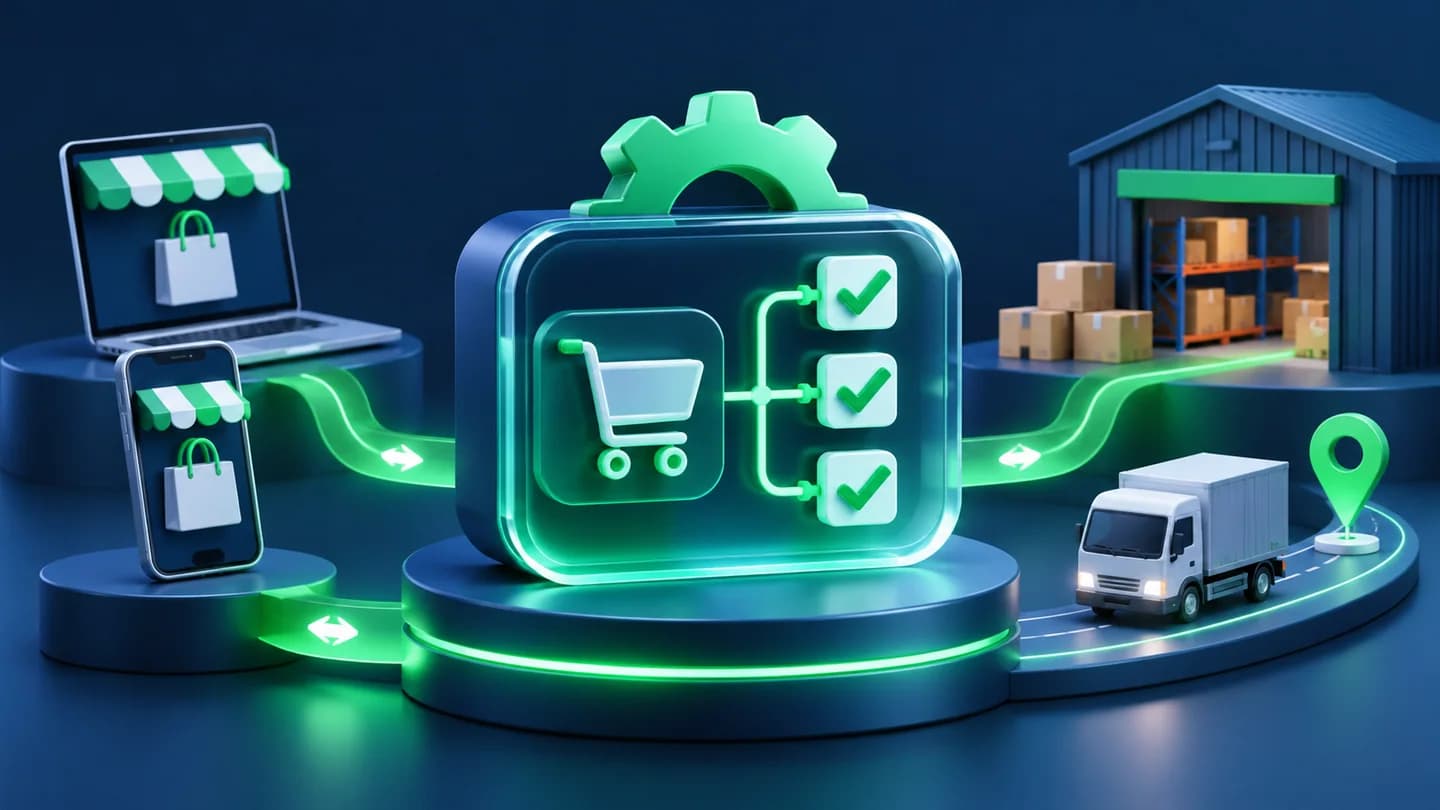
Splicity Dynamics builds custom order management systems that connect your sales channels, warehouses, and logistics into one unified workflow. The result is faster fulfillment, fewer errors, and customers who always know where their order stands.
 E-Commerce
One order record, many channels
Website, marketplace, B2B and phone orders are normalised into the same model, so fulfilment and reporting do not depend on where the order came from.
Fulfilment rules you define
Warehouse selection, order splitting, priority handling and carrier choice follow your rules and constraints rather than a fixed workflow.
Returns treated as part of the flow
Returns, exchanges and refunds are modelled alongside orders, so stock, payments and customer communication stay consistent.
Order Management System
The outcome we're after
Orders arrive from a website, a marketplace, a phone call and a sales rep's WhatsApp, and each lands in a different format. Teams then re-key them, ship the wrong item, or discover a stock shortage after the customer has paid. The order is the unit of work that touches sales, warehouse, logistics and finance, so its lifecycle has to be explicit.
We design an order management build around a clear lifecycle and one order model. Channel connectors bring orders in, the system validates them, allocates stock or sourcing, splits them across warehouses or suppliers when required, creates fulfilment tasks, books shipments with carriers and handles returns and exchanges. It treats stock as something it reserves from, rather than something it owns, so it can work with whatever inventory system you run.
At the end you own the order model, the channel connectors and the fulfilment rules. When a new channel or carrier is added, it is a connector rather than a restructuring of how orders work.
What we deliver
Key offerings
Scope
What a custom order management system build includes
Order model and lifecycle
Orders, lines, shipments, returns and adjustments with a defined set of states and permitted transitions.
Channel connectors
Inbound adapters for storefronts, marketplaces, B2B portals and manual entry, with duplicate detection and mapping of products and SKUs.
Allocation and sourcing
Reserve stock from the right location, split across warehouses, backorder or route to dropship suppliers based on rules.
Fulfilment workflow
Pick lists, pack confirmation with scan checks, invoice generation and handover to carrier.
Carrier and shipping integration
Rate comparison, label generation, tracking updates and cash-on-delivery handling through shipping aggregator or carrier APIs.
Returns and exchanges
Return requests, reason codes, inspection, restock or write-off decisions and refund triggers.
Customer notifications
Order, shipping and delivery updates through email, SMS and WhatsApp, with templates you control.
Engineering
Architecture and technology
Orders are modelled as an event-sourced or state-machine aggregate so every change is recorded and replayable, which helps when channels send conflicting updates. Inbound channel messages go through a queue with idempotency keys derived from the channel's order identifier, so a repeated webhook cannot create a second order. Stock is accessed through a reservation interface, which lets the system connect to our own inventory ledger or to an existing ERP. Carrier calls are asynchronous with retries, and a clear failed-booking state is surfaced to operators. We use a modular backend so allocation rules can change without touching channel code.
Typical stack
- Node.js or Python (Django)
- PostgreSQL
- Redis
- RabbitMQ or BullMQ
- React
- Webhooks and REST integrations
- Docker
- OpenTelemetry
Delivery
How we deliver it
- 01
Order flow mapping
We trace an order from every entry channel to delivery and return, and record where it stalls and where data is retyped.
- 02
Order model and first connector
The core model, lifecycle and one channel connector are built and run with real order samples.
- 03
Allocation and fulfilment
Sourcing rules, picking, packing and invoice generation are built and tested with the warehouse team.
- 04
Carriers, returns and notifications
Shipping integrations, return flows and customer messaging are added and exercised against live accounts.
- 05
Parallel run and channel expansion
Orders flow through the new system alongside the old process, then remaining channels are connected one at a time.
Planning
What drives cost and timeline
- Number of sales channels and the quality of their APIs.
- Complexity of sourcing rules, such as multi-warehouse splitting and dropship.
- Number of carriers and shipping aggregators to integrate.
- Whether B2B features like quotes, credit terms and approvals are included.
- Return and exchange workflows, including quality inspection.
- State of the inventory and accounting systems it must connect to.
India: compliance and market notes
- Invoices generated at fulfilment need GSTIN, HSN codes and the correct CGST and SGST or IGST treatment by place of supply.
- Cash on delivery orders need a remittance reconciliation flow with the carrier or aggregator.
- Sellers on e-commerce platforms are subject to the Consumer Protection (E-Commerce) Rules 2020, which affects return and grievance handling.
- Order notifications by SMS need DLT-registered templates, and WhatsApp notifications need opt-in.
General information, not legal or tax advice.
Comparing ready-made options first? Read our guide to order management software.
Why Splicity
Why teams choose us for this
A senior team, a fixed plan and long-term ownership — the things that decide whether a project actually succeeds.
One accountable team
Strategy, design, build and support handled end to end by senior people — not handed off and lost.
Fixed, transparent scope
A clear plan and estimate before any work begins. No open-ended billing, no surprises.
Built to scale & rank
Performance, security and SEO engineered in from day one — not bolted on at the end.
A long-term partner
We support, monitor and evolve what we build, so it keeps delivering value long after launch.
FAQ
Frequently asked questions
How is this different from an inventory system?
Inventory tracks what you hold and where. Order management tracks what customers have bought and what must happen to deliver it. The two connect through reservations and shipments.
Can it sit on top of our existing ERP or e-commerce platform?
Yes. A common design is an order layer that pulls from several channels and pushes confirmed orders and invoices into the ERP, leaving that system as the financial record.
Do we own the code?
Yes. Code, database and integrations are transferred at handover with documentation of the lifecycle and rules.
When is a ready order management product enough?
If your channels and carriers are mainstream and rules are simple, a configured product is faster. Custom work is justified by unusual sourcing, B2B workflows or integration with in-house systems.
How we build it
Related projects & blueprints
E-Commerce · Solution blueprint
Headless Commerce Replatform
How we move a slow, plugin-heavy online store to a headless architecture — a fast storefront on a modern commerce engine — while protecting existing search rankings, payment flows and operations.
Read the blueprint →
More in E-Commerce & Business Solutions
Related services
Subscription & Membership Platform
We design and develop subscription and membership platforms that handle recurring billing, tiered access, and lifecycle automation from day one. The result is predictable monthly revenue and a member experience your customers actually want to stay for.
Explore→
Loyalty & Rewards System
We design and develop gamified loyalty and rewards platforms tailored to your business model, from tiered point systems to milestone-based incentives. Clients see measurable increases in repeat purchase rates and customer lifetime value within the first quarter.
Explore→
Live Chat & Support Integration
We configure and integrate live chat and helpdesk platforms — Intercom, Freshdesk, and Zendesk — directly into your website or app. The result is a support layer that reduces response times, keeps customers informed, and frees your team from repetitive manual work.
Explore→
WhatsApp Business API Integration
Splicity Dynamics builds end-to-end WhatsApp Business API integrations that connect your messaging layer directly to your CRM, order management, and support workflows. The result is faster response times, higher conversion rates, and a customer experience that feels personal at scale.
Explore→
Customer Data Platform (CDP)
We design and implement Customer Data Platforms that stitch together behavioural, transactional, and demographic data into a single, persistent customer record. Clients gain a reliable foundation for personalisation, retention campaigns, and revenue forecasting.
Explore→
Business Intelligence (BI) Dashboard
We design and build Business Intelligence dashboards that consolidate your metrics into a single, live view tailored to your workflows. The result is a team that stops guessing and starts acting on facts.
Explore→Ready to start your order management system project?
Tell us what you're building. We'll scope it and come back with a clear plan, timeline and estimate.